

The Reserve Bank of India's Monetary Policy Committee (MPC) cut the repo rate by 25 basis points on April 9, 2026 — the second consecutive cut in 2026, following the February 2026 cut that ended a 57-month rate pause. The repo rate now stands at 6.00%, its lowest since March 2022.
For India's 27+ million active home loan borrowers, this is meaningful news. If your loan is linked to EBLR (External Benchmark Lending Rate), your bank is mandated to pass through this cut within 90 days. The question is: how much do you actually save?
The short answer: On a ₹50 lakh, 20-year floating-rate home loan, the April 2026 cut saves approximately ₹770–₹900 per month. The cumulative saving from both 2026 cuts (50 bps total) is ₹1,500–₹1,800 per month.
Why the RBI Cut Rates in April 2026
The MPC's April 2026 decision was unanimous in direction (5–1 to cut) and guided by three converging data points:
- Inflation below target: CPI inflation eased to 3.34% in February 2026, comfortably below the RBI's 4% upper tolerance band. Food inflation, which had been the primary upside risk throughout 2023–25, has moderated significantly.
- Growth needs support: GDP growth for FY 2025-26 is tracking at approximately 6.5% — solid by global standards but below India's structural potential of 7%+. The MPC judged that rates at 6.25% were still restrictive in real terms.
- Global conditions: FII outflows from India ($9.57 billion in March 2026 alone) have increased the cost of equity capital. A repo rate reduction helps anchor domestic demand even as external capital is volatile.
RBI repo rate trajectory 2020–2026 — from pandemic lows to post-hike cycle and 2026 easing. Source: RBI monetary policy statements.
The chart above shows India's rate cycle from the pandemic-era emergency cuts (4.00%, May 2020) through the aggressive tightening phase (6.50%, February 2023) and now into the 2026 easing cycle. The current 6.00% level is 50 basis points below the cycle peak.
EBLR vs MCLR: Who Gets Relief Faster?
Not all home loan borrowers benefit at the same speed. The critical variable is your loan's benchmark rate:
| Loan Type | Linked To | Transmission Speed | Banks (examples) |
|---|---|---|---|
| Repo-linked (EBLR) | RBI Repo Rate directly | Within 1–3 months (RBI mandated) | SBI, HDFC Bank, ICICI Bank, Kotak, Axis |
| MCLR-linked (older loans) | Bank's marginal cost of funds | 6–12 months (depends on reset date) | Mostly pre-2019 loans; being phased out |
| Fixed rate | Fixed at origination | No transmission | Select bank products, NBFCs |
If you took a home loan before October 2019 and have not switched to EBLR, you are on MCLR. Switching to EBLR typically costs 0.25%–0.50% of outstanding principal as a one-time conversion fee. In the current 2026 rate-cut cycle, if you have more than 10 years remaining, the math usually favours switching.
Key check: Call your bank and ask: "Is my home loan on EBLR or MCLR?" If MCLR, ask for the conversion fee and use the Prepayment Calculator to model whether switching now saves you more than the one-time fee.
EMI Savings by Loan Size — Full Table
The table below models the exact monthly EMI reduction for three common loan sizes at the two 2026 cut levels (25 bps = April cut alone; 50 bps = both 2026 cuts combined). Base rate assumption: 8.75% EBLR-linked floating rate (SBI EBLR as of March 2026), 20-year tenure.
Monthly EMI reduction per loan size at 25 bps and 50 bps total rate cuts — 20-year tenure, EBLR-linked floating rate. Calculated using standard EMI amortisation formula.
| Loan Amount | EMI @ 8.75% | EMI @ 8.50% (–25 bps) | Monthly Saving | EMI @ 8.25% (–50 bps) | Monthly Saving |
|---|---|---|---|---|---|
| ₹30,00,000 | ₹26,584 | ₹26,122 | ₹462/month | ₹25,662 | ₹922/month |
| ₹50,00,000 | ₹44,306 | ₹43,537 | ₹769/month | ₹42,770 | ₹1,536/month |
| ₹75,00,000 | ₹66,459 | ₹65,305 | ₹1,154/month | ₹64,155 | ₹2,304/month |
These figures assume the full 25/50 bps is passed through immediately. In practice, EBLR-linked loans typically see full transmission within 1–3 months. Use the EMI Calculator to enter your exact loan amount, current rate, and remaining tenure for your personalised saving.
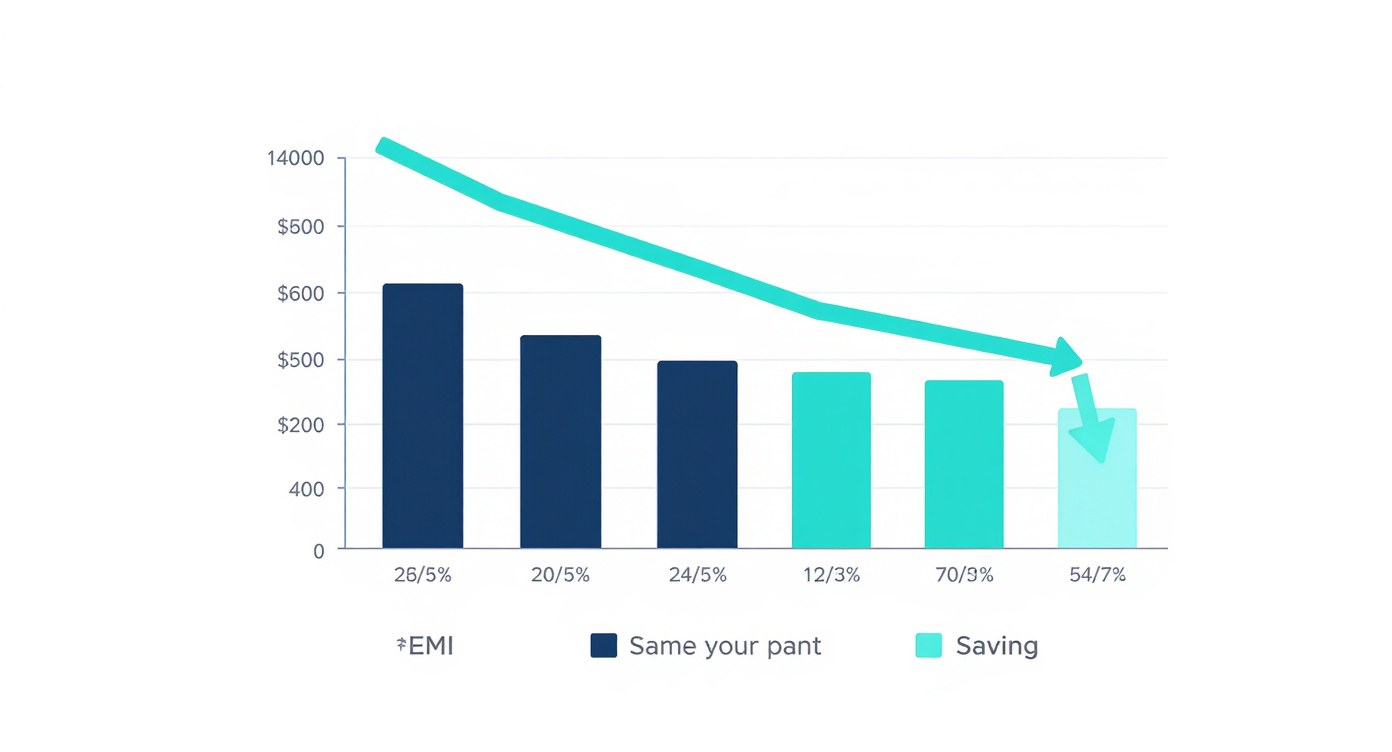
If you keep your EMI the same instead of reducing it, the extra principal repayment shortens your loan tenure. For a ₹50L loan, maintaining the original EMI after a 50 bps cut reduces the remaining tenure by approximately 18–22 months — saving over ₹3.5 lakh in total interest.
Model this using the Home Loan Prepayment Calculator — enter the EMI difference as a monthly prepayment to see tenure reduction and interest saved.
FD Rates: What Depositors Should Expect
Rate cuts are a double-edged sword: borrowers win, but FD depositors lose. Banks typically reprice their deposit rates within 1–3 months of an RBI cut. Here is what the transmission typically looks like:
| FD Tenure | Pre-Cut Rate (Mar 2026) | Expected Post-Cut Rate | Change |
|---|---|---|---|
| 91 days | 5.50% | 5.35%–5.50% | –0 to –15 bps |
| 1 year | 6.80% | 6.60%–6.65% | –15 to –20 bps |
| 2–3 years | 7.00% | 6.75%–6.85% | –15 to –25 bps |
| 5 years (tax-saving) | 6.50% | 6.30%–6.40% | –10 to –20 bps |
If you are planning a large FD, consider locking in the current rate before your bank revises downward. However, do not over-rotate from equities to FDs in response to this cut — the real (inflation-adjusted) FD return at 6.80% with 3.34% CPI is only ~3.3%, while equity SIPs have historically delivered 12–14% nominal CAGR over long periods.
Use the FD Calculator to model your maturity value at current vs expected post-cut rates.
What Should You Do Now?
| Your Situation | Recommended Action | Rationale |
|---|---|---|
| EBLR home loan, 10+ years remaining | Keep EMI flat, enjoy tenure reduction | Saves maximum total interest; loan paid off earlier |
| MCLR home loan, 10+ years remaining | Enquire about EBLR conversion cost | 50 bps savings over remaining tenure likely exceeds one-time fee |
| EMI reduction received, monthly surplus | Start a SIP with the saving amount | ₹770–₹1,540/month at 12% CAGR over 15 years = ₹3.9L–₹7.7L extra corpus |
| Large FD maturing in next 3 months | Lock in at current rates before revision | Banks typically reduce FD rates 4–8 weeks after RBI cut |
| Considering a new home loan | EBLR-linked loan is the right choice now | In a falling rate cycle, floating EBLR beats fixed rates |
The Verdict
- ₹50L home loan saves ₹769/month from the April 2026 cut alone; ₹1,536/month if you count both 2026 cuts cumulatively. Real savings depend on your lender's reset timeline.
- EBLR borrowers benefit first — transmission within 90 days is mandatory. MCLR borrowers should evaluate switching if tenure remaining exceeds 10 years.
- FD rates will fall — if you have a large deposit to make, act before your bank revises rates downward (typically 4–8 weeks after the MPC decision).
- Redirect the saving wisely — either into loan prepayment (saves more interest) or a new SIP (builds parallel wealth). Use the Home Loan Prepayment Calculator and SIP Calculator to model both options.
Sources & Citations
Data sources: RBI — Monetary Policy Press Releases (April 9, 2026); BusinessToday — RBI Rate Cut EMI Impact (April 3, 2026); RBI — EBLR Circular (Implementation Guidelines). EMI calculations verified using the UtilsDaily EMI Calculator.