

UtilsDaily
Dramatic staircase of ascending coin stacks on dark slate — smallest silver coins at left, tallest gold coin tower at right — lit by horizontal teal light beams with a rupee symbol engraved on the top coin, representing step-up SIP wealth accumulation

Step-Up SIP vs Flat SIP: How a 10% Annual Increase Builds ₹1.06 Crore vs ₹49.9 Lakh

India's SIP inflows hit ₹29,845 crore in February 2026. The question most investors never ask: should you increase your SIP every year? The numbers are compelling.

India Finance ·9 min read ·

India's monthly SIP inflows hit ₹29,845 crore in February 2026 — a 15% year-on-year increase — confirming that systematic investing through mutual funds has become genuinely mainstream. Over 10 crore SIP accounts are now active, and the industry crossed ₹3 trillion in annual SIP inflows for the first time in 2025.

But here is the gap most investors never address: nearly all of them run a flat SIP. The same ₹5,000 or ₹10,000 per month that they set up in 2020 or 2022 — unchanged, while their salary has likely grown 30–50%. That stagnant SIP amount is quietly costing them a crore.

The short answer: A step-up SIP starting at ₹5,000/month with a 10% annual increase builds ₹1.06 crore in 20 years at 12% CAGR. A flat ₹5,000/month SIP at the same return builds ₹49.9 lakh. The difference is ₹56.1 lakh — more than double the corpus.

SIP inflow data sourced from AMFI monthly data (March 2026) and cross-verified via Free Press Journal (March 2026). Corpus projections calculated using the UtilsDaily Step-Up SIP Calculator and verified against the SIP Calculator.

SIP Momentum: ₹29,845 Crore in February 2026

The AMFI data for February 2026 confirms that India's retail SIP investor base is growing and resilient:

India mutual fund SIP inflow data — recent monthly figures. Source: AMFI, March 2026.
Month SIP Inflows Year-on-Year Change Note
February 2026 ₹29,845 crore +15% YoY Slight dip from Jan due to shorter month
January 2026 ₹31,000+ crore +18% YoY Second consecutive month above ₹31K crore
December 2025 ₹31,000+ crore +17% YoY First month to cross ₹31K crore ever
Full year 2025 ₹3+ trillion First time annual SIP crossed ₹3T Milestone year for Indian mutual funds

This sustained SIP growth — even during the Sensex correction from 86,159 (December 2025) to ~73,000 (March 2026) — demonstrates that Indian retail investors are maturing. They are not panic-selling during corrections; they are continuing their mandates. That is exactly the right behaviour. But a flat SIP in a growing-income environment is still leaving significant wealth on the table.

What Is a Step-Up SIP and How Does It Work?

A step-up SIP (or top-up SIP) adds one parameter to a regular SIP: an annual increase percentage. Every year — typically on the anniversary date of your SIP — the monthly contribution automatically increases by that percentage.

Step-up SIP: how ₹5,000/month grows with a 10% annual step-up over 10 years
Year Monthly SIP Amount Annual Contribution Cumulative Invested
Year 1 ₹5,000 ₹60,000 ₹60,000
Year 2 ₹5,500 ₹66,000 ₹1,26,000
Year 3 ₹6,050 ₹72,600 ₹1,98,600
Year 5 ₹7,326 ₹87,912 ₹3,66,312
Year 10 ₹11,789 ₹1,41,468 ₹9,56,244
Year 15 ₹18,973 ₹2,27,676 ₹19,26,360
Year 20 ₹30,617 ₹3,67,404 ₹34,37,880

Notice that by Year 10, you are investing ₹11,789/month — what started as a modest ₹5,000 SIP is now a substantial contribution. But crucially, each of those earlier years' investments has been compounding for 10–15+ years. That compounding head start is what drives the ₹1.06 crore outcome.

The Maths: ₹1.06 Crore vs ₹49.9 Lakh

The fundamental reason step-up SIPs outperform is simple: more capital deployed earlier, compounding for longer. Here is the full comparison:

Flat SIP 10yr 1.15M Step-Up SIP 10yr 1.8M Flat SIP 15yr 2.5M Step-Up SIP 15yr 5.01M Flat SIP 20yr 4.99M Step-Up SIP 20yr 10.6M

Step-Up SIP (₹5,000/month + 10% annual increase) vs Flat SIP (₹5,000/month) — corpus comparison at 10, 15, and 20 years at 12% CAGR. Source: Calculated using UtilsDaily Step-Up SIP Calculator.

Step-Up SIP (10% annual increase) vs Flat SIP — corpus, total invested, and return multiple at 12% CAGR. Calculated using UtilsDaily Step-Up SIP Calculator.
Scenario 10 Years 15 Years 20 Years
Flat SIP ₹5,000/month — Corpus ₹11.5 lakh ₹25.0 lakh ₹49.9 lakh
Step-Up SIP (10% p.a.) — Corpus ₹18.0 lakh ₹50.1 lakh ₹1.06 crore
Flat SIP — Total Invested ₹6.0 lakh ₹9.0 lakh ₹12.0 lakh
Step-Up SIP — Total Invested ₹9.6 lakh ₹19.3 lakh ₹34.4 lakh
Extra corpus from step-up +₹6.5 lakh +₹25.1 lakh +₹56.1 lakh
Year 1: ₹5,000 5K Year 3: ₹6,050 6.1K Year 5: ₹7,326 7.3K Year 8: ₹9,744 9.7K Year 10: ₹11,789 11.8K Year 15: ₹18,973 19K Year 20: ₹30,617 30.6K

How ₹5,000/month grows with 10% annual step-up — monthly SIP amount at key milestones. The contribution itself compounds even before market returns are applied.
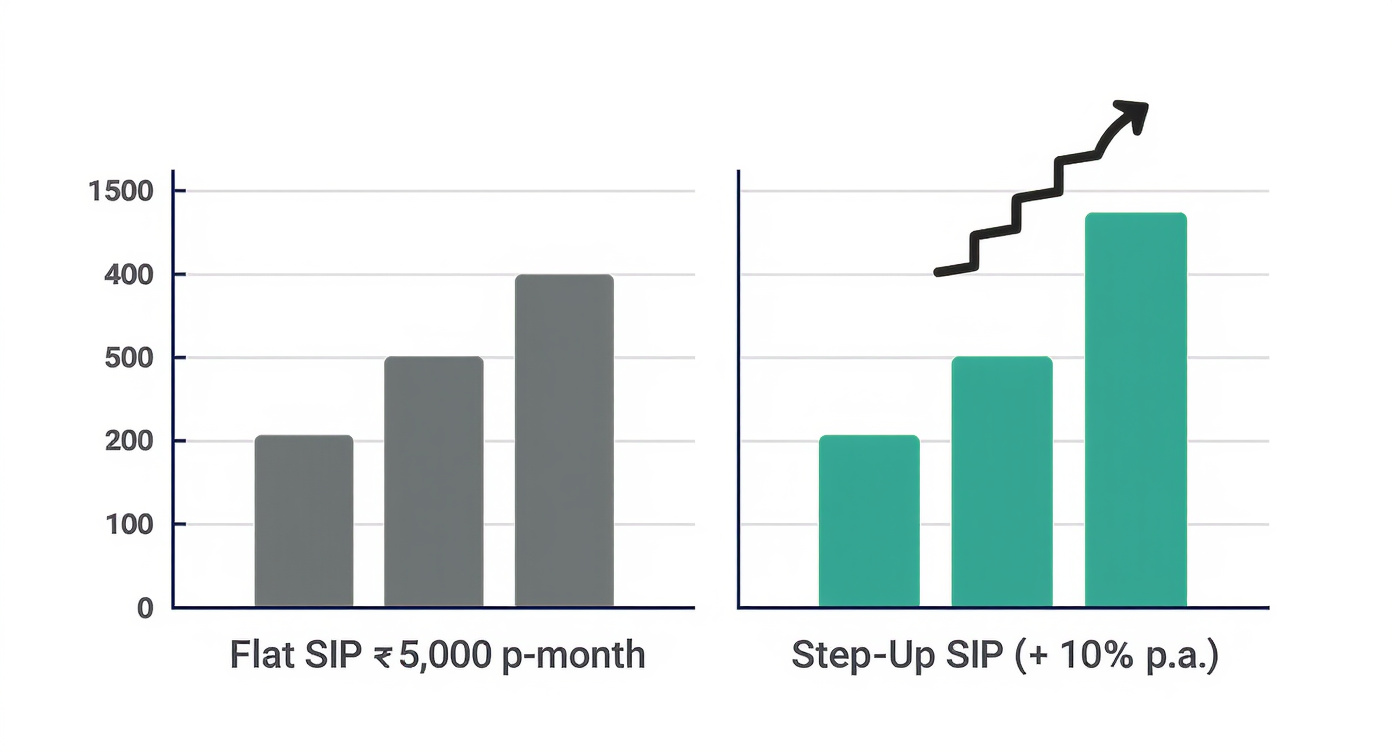
Two side-by-side bar charts: left shows Flat SIP corpus at 10/15/20 years in slate grey, right shows Step-Up SIP at same intervals in teal with notably taller 20-year bar — illustrating the ₹56 lakh corpus difference
The step-up effect compounds over time: the gap is ₹6.5 lakh at 10 years, widens to ₹25 lakh at 15 years, and reaches ₹56 lakh at 20 years — because the additional contributions in later years have more years of compounding ahead of them.

How Much Should You Step Up — and When?

The practical answer: step up by your salary increment percentage, every April. Here is the framework:

Step-up rate guide — recommended annual SIP increase by situation and financial goal
Your Situation Recommended Step-Up 20-Year Corpus (₹5,000 start, 12% CAGR)
Conservative / modest hike years 5%–7% p.a. ₹66–₹78 lakh
Standard salary growth 10% p.a. ₹1.06 crore
High-growth career / above-average hike 15% p.a. ₹1.52 crore
Variable (step up only in good years) 5–15% when feasible Varies, but still significantly beats flat SIP

April rule: Every year in April, look at your salary increment letter. Take the increment percentage and apply the same increase to your SIP amount. You will not feel the difference in lifestyle — your net take-home also went up — but the compounding impact over 15–20 years is transformative.

How to Use the Step-Up SIP Calculator

The UtilsDaily Step-Up SIP Calculator lets you model any combination of starting SIP amount, annual step-up percentage, expected return, and tenure:

  1. Starting SIP amount: Enter what you can invest today — even ₹500/month is a valid starting point.
  2. Annual step-up %: Enter your expected salary growth rate (10% is a reasonable default for India's urban workforce).
  3. Expected return: 12% is a common long-term assumption for diversified equity funds; use 10% for a conservative estimate.
  4. Investment tenure: Enter 15–20 years for long-term wealth goals. The step-up effect is most dramatic beyond 12 years.

Use the XIRR Calculator to verify the actual return rate on your existing SIP history — it accounts for the irregular cash flow pattern of a step-up SIP more accurately than simple CAGR. For comparison, model the same total invested amount as a lump sum using the Lumpsum Calculator to see why time-in-market and early deployment beats waiting to accumulate a larger single sum.

The Verdict

  1. A step-up SIP doubles your 20-year corpus on the same starting investment — ₹1.06 crore vs ₹49.9 lakh at 12% CAGR with a 10% annual step-up.
  2. April is the ideal month to step up — your salary increment has just been applied, and the new financial year is a natural reset point.
  3. Any step-up is better than none — even a 5% annual increase adds ₹16 lakh more than a flat SIP at 20 years.
  4. Start today — the step-up benefit is front-loaded: the earlier you begin the compounding clock, the more each year's additional contribution is worth. Use the Step-Up SIP Calculator to compute your own 20-year number right now.

Sources & Citations

Data sources: AMFI — Monthly SIP Inflow Data (February 2026, March 2026); Free Press Journal — SIP Inflows ₹29,845 Crore (March 2026). All corpus projections calculated using the UtilsDaily Step-Up SIP Calculator and cross-verified against the SIP Calculator.

Disclaimer: This article is for informational and educational purposes only. It does not constitute financial or investment advice. Mutual fund investments are subject to market risks. Returns used in projections (12% CAGR) are illustrative and not guaranteed. Past performance does not guarantee future results. Please read all scheme-related documents and consult a SEBI-registered investment advisor before investing.

Frequently Asked Questions

What is a step-up SIP in mutual funds?
A step-up SIP (also called a top-up SIP) is a Systematic Investment Plan where you automatically increase your monthly contribution by a fixed percentage each year. For example, starting at ₹5,000/month with a 10% annual step-up means: Year 1 = ₹5,000/month, Year 2 = ₹5,500/month, Year 3 = ₹6,050/month, and so on. All major fund houses — Mirae, Axis, Kotak, SBI, HDFC MF — allow you to set up step-up SIPs online through their portals or through platforms like Groww, Kuvera, and Zerodha Coin.
How much more does a step-up SIP earn compared to a flat SIP?
Starting at ₹5,000/month with a 10% annual step-up and 12% CAGR: after 20 years, the corpus is approximately ₹1.06 crore. A flat SIP of ₹5,000/month at the same 12% CAGR over 20 years gives ₹49.9 lakh. The step-up strategy builds ₹56.1 lakh more — a 112% larger corpus — on the same starting investment amount. The total amount invested in the step-up SIP is also higher (approximately ₹34.4 lakh vs ₹12 lakh for flat), but the return rate on the additional investment is significantly higher than most fixed-income alternatives. Use the UtilsDaily Step-Up SIP Calculator to model your exact numbers.
What is the ideal percentage to step up a SIP each year?
The most practical approach is to step up your SIP by the same percentage as your annual salary increment. If you receive a 10% raise, increase your SIP by 10% — you maintain the same proportional savings rate while your lifestyle spending also increases. A minimum step-up of 5%–7% annually is meaningful: at 7%, a ₹5,000 SIP grows to ₹8,000 after 8 years and your 20-year corpus at 12% CAGR is approximately ₹78 lakh (compared to ₹49.9 lakh flat). Even if some years you cannot step up, doing it consistently in good years has a compounding effect on long-term wealth.
What were India's SIP inflows in February 2026?
India's SIP inflows in February 2026 were ₹29,845 crore — a 15% year-on-year increase compared to February 2025. This follows two months of ₹31,000+ crore inflows (December 2025 and January 2026). For calendar year 2025, total SIP inflows crossed ₹3 trillion for the first time. The total mutual fund industry AUM as of February 28, 2026 stood at ₹82.03 trillion, with SIP AUM at approximately ₹13.47 lakh crore. Source: AMFI monthly data, March 2026.
Can I set up a step-up SIP on existing funds or only new investments?
You can convert an existing flat SIP to a step-up SIP without exiting the fund or triggering capital gains tax. Log into your fund house's portal (Mirae, Axis, SBI MF, HDFC MF, etc.) or your investment platform (Groww, Kuvera, Zerodha Coin, MF Central) and modify your SIP mandate to add a top-up amount or percentage. The new step-up starts from your next SIP installment. Note: with some registrars (CAMS/KFintech), the process requires a fresh mandate — check with your platform.
Does a step-up SIP work better than starting a lump sum later?
A step-up SIP beats the strategy of 'I'll invest a lump sum when I have more money later' for one key reason: time. The earliest rupees you invest compound the longest. Waiting 5 years to invest a larger lump sum typically underperforms a step-up SIP started today, because you lose 5 years of compounding on the initial amount. At 12% CAGR, every ₹1 lakh invested today is worth ₹1.76 lakh in 5 years — that 5-year head start on your first few SIP installments matters more than the larger later lump sum.
What is the best month to step up a SIP?
April is the ideal month to step up your SIP in India for two reasons: (1) April 1 is the start of the new financial year — most salaried employees receive their annual increment in March–April, making April the natural month to align savings with the new salary level; (2) April is the start of fresh 80C investment planning for FY 2026-27 — stepping up an ELSS SIP in April means you begin the new tax year at a higher savings rate. Set a calendar reminder: every April, increase your SIP by your salary hike percentage using the UtilsDaily Step-Up SIP Calculator to pre-compute the long-term impact.
Is a step-up SIP available in ELSS (tax-saving) mutual funds?
Yes. Step-up SIPs are available in ELSS funds, but with one important caveat: each SIP installment has a separate 3-year lock-in from the date of investment under Section 80C rules. When you step up by ₹500/month, those additional ₹500 units also have their own 3-year lock-in from the date they are purchased. This means redemptions from a step-up ELSS SIP need careful tracking of which installments have completed their lock-in. Most platforms show installment-level lock-in dates in the portfolio view. The tax saving on the stepped-up amount is also eligible for 80C deduction in the old tax regime.