

On March 25, 2026, the IBJA 24-karat gold rate stood at ₹1,46,670 per 10 grams — that is ₹14,667 per gram. On December 31, 2024, the same 24K gold was priced at ₹77,560 per 10 grams. In just 15 months, gold has risen by approximately 89%, outperforming most equity indices, fixed deposits, and debt instruments over the same window.
Retail investors across India are asking two questions: Is it too late to buy? And if I do buy, which vehicle should I use — Sovereign Gold Bond (SGB), Gold ETF, or physical gold? These are not simple questions at ₹1.47 lakh per 10 grams, especially with the SGB programme currently on pause.
This article breaks down all three options on availability, returns, tax treatment, costs, and practical suitability — using verified IBJA data and RBI guidelines. Gold crossed the psychological ₹1 lakh milestone in 2025. At ₹1.47 lakh today, the decisions you make about your gold allocation matter more than ever.
Gold ETF is the most practical choice in 2026. No new SGB has been issued since February 2024, and physical gold carries GST (3%) plus making charges. Here is what to do with your gold allocation today.
Why Gold Is Surging in 2026
Gold's 89% rise in 15 months is not a single-cause story. Three structural forces are driving prices simultaneously, and each has legs that extend well into 2026 and beyond.
1. Relentless central bank buying. According to the World Gold Council, global central banks purchased a record 1,045 tonnes of gold in 2024 — the third consecutive year above 1,000 tonnes. India's RBI is among the active buyers, steadily adding to its gold reserves as a hedge against dollar dependency. This sustained institutional demand creates a structural floor under gold prices that retail selling cannot easily break.
2. Dollar uncertainty and US tariff volatility. After SCOTUS rulings on IEEPA tariff authority in February 2026, the US dollar experienced heightened volatility. Gold prices move inversely to the dollar — as confidence in US monetary policy and trade stability wavers, gold strengthens. The combination of US tariff unpredictability and an accommodative Fed posture has reinforced gold's safe-haven appeal globally.
3. Geopolitical safe-haven premium. Ongoing US-Iran tensions and the continued Russia-Ukraine conflict have kept geopolitical risk premiums embedded in gold. Historically, sustained geopolitical uncertainty adds 5–12% to gold's base price. That premium has been persistent rather than transient in this cycle.
The ₹1 lakh milestone was crossed in 2025. Gold is now up 89% since December 2024 in just 15 months — well ahead of most equity indices over the same period. This is an extraordinary run; understanding whether it continues requires watching central bank demand data, the dollar index, and India's own monetary policy signals.
Gold's 10-Year Track Record in India
Before deciding whether to invest at current prices, it helps to understand gold's actual historical performance in India. The table below uses IBJA annual average prices for 2015–2023 and the December 31, 2024 closing price as the 2024 data point.
| Year | Avg. Price per 10g (₹) | Annual Return (%) |
|---|---|---|
| 2015 | ₹26,671 | Base year |
| 2016 | ₹30,128 | +12.96% |
| 2017 | ₹29,174 | −3.17% |
| 2018 | ₹30,692 | +5.21% |
| 2019 | ₹35,154 | +14.53% |
| 2020 | ₹47,562 | +35.30% |
| 2021 | ₹47,437 | −0.26% |
| 2022 | ₹52,670 | +11.03% |
| 2023 | ₹65,330 | +24.04% |
| 2024* | ₹77,560* | +18.73%* |
*December 31, 2024 closing price from Goodreturns / 5paisa.
Year-on-year change in 24K gold price per 10g (INR) 2016–2024 — annual average IBJA data. Source: ibja.co, Goodreturns.
Over this 10-year period, gold delivered a CAGR of approximately 12.5% per year. March 2026's price of ₹1,46,670 represents a further 89% jump from December 2024 — a move compressed into just 15 months. The 10-year CAGR, however, also shows that gold is not linear: 2017 and 2021 delivered negative returns. Investors expecting steady annual gains will be disappointed — gold moves in cycles, and the current cycle has been exceptionally strong.
How to Invest in Gold in 2026
With SGB on pause since February 2024 and no new series announced for FY2025-26 or FY2026-27, investors have three practical options. Understanding the differences in cost, tax, and convenience is essential before committing capital.
| Feature | SGB | Gold ETF | Physical Gold |
|---|---|---|---|
| Availability in 2026 | ❌ No new issues since Feb 2024 | ✅ On NSE/BSE exchanges | ✅ Jewellers and banks |
| Returns | Gold price + 2.5% p.a. interest (semi-annual) | Tracks gold price (minus ~0.5% expense ratio) | Gold price (minus making charges 8–25%) |
| Tax on profit | Zero capital gains (if held to 8-year maturity) | 12.5% LTCG after 24 months | 12.5% LTCG after 24 months |
| Buying costs | Issue price only (no GST) | Market price + ~0.5% TER annually | Spot price + 3% GST + making charges |
| Storage | Government — no physical custody | Demat account — no physical custody | Physical possession; bank locker advisable |
| Minimum investment | 1 gram (max 4 kg per individual per FY) | ~₹1 (fractional ETF units available) | 1 gram or 1 coin typically |
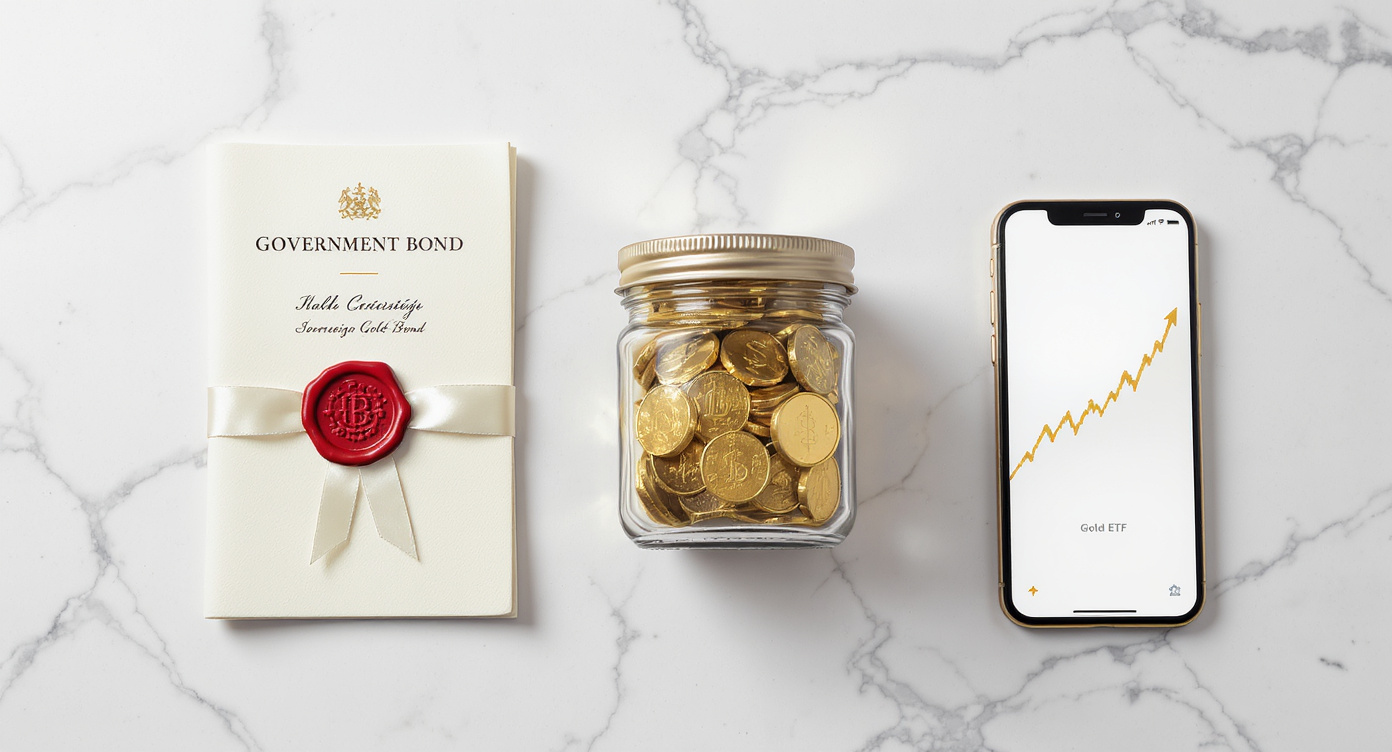
The verdict on the comparison table is stark: SGB is the best vehicle on nearly every dimension — except it is currently unavailable. Gold ETF is the practical default in 2026. Physical gold, for investment purposes, is the least efficient option by a wide margin once you account for GST and making charges.
The Tax Advantage of SGB — When It Comes Back
The Sovereign Gold Bond tax exemption is one of the most underappreciated advantages in Indian retail investing. Under Section 47 of the Income Tax Act, capital gains arising on redemption of SGBs at maturity (8 years) are completely exempt from capital gains tax. This applies regardless of the profit amount — there is no LTCG threshold to navigate.
Contrast this with Gold ETFs and physical gold, where the July 2024 Union Budget introduced a flat 12.5% Long-Term Capital Gains (LTCG) tax on profits after 24 months of holding. Short-term gains (held less than 24 months) are taxed at your applicable income tax slab — potentially 30% for higher-income investors.
Consider a concrete example. Suppose you invest ₹1,46,670 today in a Gold ETF (equivalent to 10 grams at the current price), and gold rises to ₹2,20,000 per 10g in three years. Your profit is ₹73,330. At 12.5% LTCG, you owe ₹9,166 in tax. Had this been an SGB held to maturity: ₹0 in tax. On larger investments, this difference compounds meaningfully — on a ₹10 lakh Gold ETF position with a 50% gain, the LTCG bill is approximately ₹62,500. An SGB investor in the same position pays nothing.
The 2.5% annual interest on SGBs is an additional advantage — it is paid semi-annually and taxed as income, but it still adds approximately 2.5 percentage points to the total return over the 8-year tenure.
Track RBI's website (rbi.org.in) for the next SGB issue. When new series open, SGB becomes the unambiguous winner for 3–5+ year investors who can commit to the 8-year tenure (or at minimum, 5 years for early exit). Until then, Gold ETF is your best available substitute.
Should You Buy Gold at ₹1.47 Lakh Per 10g?
The question of timing is never simple for any asset at an all-time high. Gold at ₹1,46,670 per 10g is the highest it has ever been in India. That is both a statement about gold's performance and a caution about forward expectations. Here is a practical framework by investor type.
| Investor Type | Recommendation | Vehicle |
|---|---|---|
| Long-term (8+ years), tax-sensitive | Buy via Gold ETF now for immediate exposure; switch to SGB when a new series is announced | Gold ETF now → SGB when available |
| Medium-term (2–5 years) | Gold ETF: fully liquid, no storage hassle, tracks gold price minus a small expense ratio | Gold ETF |
| Gift or jewellery buyer | Physical gold: accept GST + making charges as part of the jewellery cost, not an investment cost | Physical gold |
Rather than a lump sum at current highs, consider using a monthly SIP into a Gold ETF. Use the SIP calculator to model how a ₹5,000 or ₹10,000 monthly investment in a Gold ETF builds over 5–10 years. Rupee cost averaging means you buy more units when gold dips and fewer units when it surges — reducing the impact of buying at today's all-time high. You can also model the lump sum growth scenario using the compound interest calculator with a 10–12% assumed annual growth rate.
At ₹1.47 lakh per 10g, gold is NOT cheap. Allocate 5–10% of your total investment portfolio to gold as a maximum. Do not chase the momentum by over-allocating. Gold has already run 89% in 15 months — the risk-reward of large new positions at these levels is asymmetric.
The Verdict
After reviewing prices, historical data, tax rules, and vehicle availability, here is where each option stands for a retail investor in India in March 2026.
- Gold ETF is your only practical option today. No new SGB has been issued since February 2024. Gold ETF gives you full 24-karat gold price upside with no physical storage risk, instant liquidity on NSE/BSE, and a fractional entry point starting at under ₹100 for some ETFs. The only downside compared to SGB is the 12.5% LTCG on profits — which is still a known, manageable cost.
- The SGB tax benefit is powerful — wait for it. When the RBI announces a new SGB series (watch rbi.org.in), it will offer 2.5% annual interest plus the full gold price return plus zero capital gains at 8-year maturity. For any investor with a long enough horizon, SGB will be the unambiguous choice the moment it becomes available again.
- At ₹1.47 lakh, do not over-allocate. Gold has surged 89% in 15 months — an extraordinary run driven by central bank buying, dollar uncertainty, and geopolitical risk. Those drivers remain, but momentum assets always carry mean-reversion risk. Stick to 5–10% portfolio allocation as your ceiling.
- History shows gold is not always up. In 2017, gold fell 3.17%. In 2021, it fell 0.26%. Over the 10-year period 2015–2024, gold delivered a CAGR of approximately 12.5% — solid, but not linear. A monthly SIP into a Gold ETF, rather than a lump sum at current highs, is the prudent approach for new investors entering today.
- Physical gold is jewellery, not investment. Between 3% GST and 8–25% making charges, physical gold requires a 11–28% price increase just to break even on the premium you paid over spot price. As a gift or a family tradition, physical gold has emotional value. As a financial investment in 2026, it is the least efficient option available.
Use UtilsDaily's SIP calculator to model monthly Gold ETF investments over 5, 10, or 15 years, or the compound interest calculator to project lump sum returns at assumed annual growth rates.
Sources & Citations
Data sources: IBJA — India Bullion and Jewellers Association (historical gold rates); Goodreturns — Daily gold rate India, historical data; RBI — Sovereign Gold Bond FAQ; World Gold Council — Central bank gold demand 2024; ClearTax — SGB 2025-26 guide. Gold prices verified against IBJA daily rates and cross-checked with Goodreturns.