

April 15, 2026 is 16 days away as of March 30. It is one of the most action-dense financial deadlines in the US calendar — and most taxpayers treat it only as a tax-filing date, missing two other significant opportunities embedded in the same deadline.
As of April 3, 2026, the S&P 500 is down approximately 7.1% year-to-date, and the Nasdaq has entered correction territory, down 13.3% from its 2026 high. This creates a specific scenario — tax-loss harvesting opportunities — that active investors should evaluate before the filing deadline.
Three things April 15 affects simultaneously: (1) Federal tax return due for tax year 2025; (2) Last day for 2025 IRA contributions ($7,000 limit); (3) Capital gains strategy cutoff — losses realised by April 15 count for the 2025 tax year if you file on time.
Why April 15 Is a Triple Deadline
Most taxpayers think of April 15 only as a tax filing date. Here is why it is actually three deadlines in one:
| Deadline | What It Covers | Can Be Extended? | Penalty for Missing |
|---|---|---|---|
| Tax return filing | Form 1040 for tax year 2025 | Yes — Form 4868 extends to Oct 15 | 5% per month failure-to-file (if owed) |
| 2025 IRA contribution | Last day for Traditional + Roth IRA 2025 | No — hard deadline, no extension | Lose the 2025 contribution slot permanently |
| Tax payment | Balance owed on 2025 return | No — must pay by Apr 15 even with extension | 0.5%/month + ~7-8% annual interest |
The IRA deadline is the most commonly missed — and the most permanently costly. You can file a late return, pay a penalty, and move on. But a missed 2025 IRA contribution slot is gone forever. You cannot "make it up" in 2026 — that year has its own separate limit.
Last Chance: 2025 IRA Contributions
Here are the 2025 IRA contribution rules, confirmed by IRS Publication 590-A:
| IRA Type | 2025 Limit (under 50) | 2025 Limit (50+) | Income Phase-Out (Single) | Income Phase-Out (MFJ) |
|---|---|---|---|---|
| Traditional IRA (deductible) | $7,000 | $8,000 | $79,000–$89,000 (if workplace plan) | $126,000–$146,000 |
| Roth IRA | $7,000 | $8,000 | $150,000–$165,000 | $236,000–$246,000 |
| Non-deductible Traditional IRA | $7,000 | $8,000 | No income limit | No income limit |
Cost of missing one year of IRA contribution ($7,000) — compounded at 8% over 10, 20, and 30 years. Missing the April 15 deadline costs far more than the $7,000 itself. Source: UtilsDaily Roth IRA Calculator.
The chart above quantifies why missing the April 15 IRA deadline is expensive. A single missed $7,000 contribution compounded at 8% over 30 years costs approximately $70,500 in lost future wealth. The opportunity cost grows with time — which is why the Roth IRA's tax-free compounding makes every on-time contribution magnified.
If you are above the Roth IRA income phase-out ($165,000 single MAGI for 2025), the backdoor Roth IRA strategy allows you to make a non-deductible Traditional IRA contribution and immediately convert it to Roth. This requires careful execution to avoid the pro-rata rule. Use the Roth IRA Calculator to model the long-term tax-free value of your contribution.
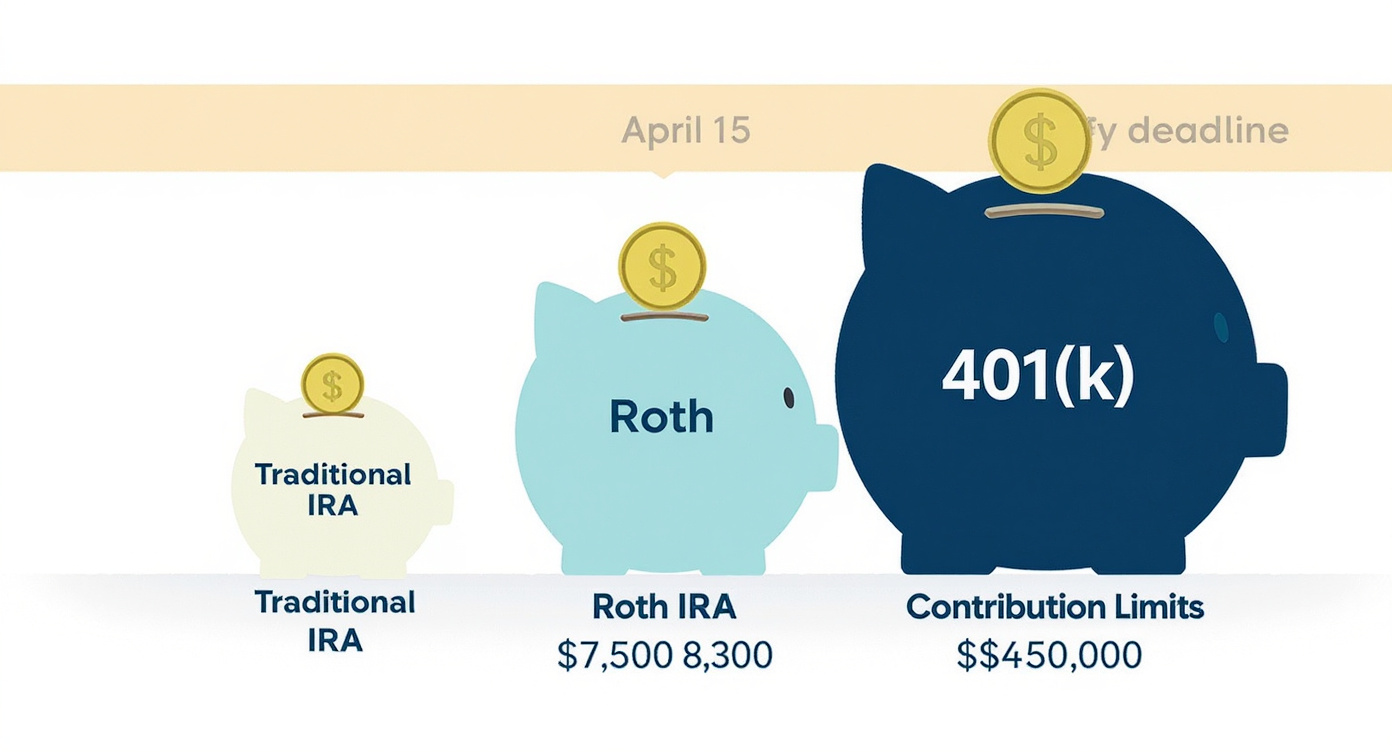
Note: the 2026 IRA limit is $7,500 (under 50) / $8,500 (50+) — contributions you make after April 15 default to the 2026 tax year. Keep this straight when making contributions to avoid IRS attribution errors.
2026 Capital Gains Tax Brackets
Understanding where you fall in the capital gains brackets is critical for two reasons: optimising when to realise gains (0% rate is available at lower incomes) and confirming tax-loss harvesting is worth the effort at your bracket.
2026 long-term capital gains tax bracket thresholds — Single vs Married Filing Jointly. The 0% rate applies to income up to $49,450 (single) / $98,900 (MFJ). Source: IRS, Kiplinger 2026 tax data.
| Rate | Single (taxable income) | Married Filing Jointly | Head of Household |
|---|---|---|---|
| 0% | $0 – $49,450 | $0 – $98,900 | $0 – $66,650 |
| 15% | $49,451 – $545,500 | $98,901 – $614,050 | $66,651 – $580,150 |
| 20% | Above $545,500 | Above $614,050 | Above $580,150 |
| +3.8% NIIT | MAGI above $200,000 | MAGI above $250,000 | MAGI above $200,000 |
0% rate strategy: If your 2025 taxable income is below $49,450 (single) or $98,900 (MFJ), you can realise long-term capital gains at zero federal tax. This is an especially powerful opportunity for retirees with low taxable income, or anyone in a low-income year. Consider harvesting gains on appreciated positions before December 31 of the qualifying year.
Tax-Loss Harvesting: S&P 500 Down 7% YTD
With the S&P 500 down approximately 7.1% year-to-date as of April 3, 2026, and the Nasdaq down 13.3% from its 2026 high, many investors hold positions with unrealised losses that can be harvested for tax benefit.
How tax-loss harvesting works in practice:
- Identify positions with unrealised losses — brokerage platforms show gain/loss per position. Focus on positions you own in taxable accounts (not IRAs or 401ks).
- Sell the losing position — this realises the capital loss. The loss first offsets capital gains; any excess up to $3,000 offsets ordinary income; losses above $3,000 carry forward.
- Immediately reinvest in a similar-but-not-identical fund — to maintain market exposure. For example, sell a Vanguard S&P 500 ETF (VOO) and buy an iShares Core S&P 500 ETF (IVV). Both track the same index but are different securities, so the IRS wash-sale rule does not apply.
- Wait 31 days — after 31 days, you may switch back to the original fund if desired.
| Your Tax Bracket | Tax Saved (vs $10K STCG) | Tax Saved (vs $10K LTCG) | Net After-Tax Value |
|---|---|---|---|
| 22% ordinary / 15% LTCG | $2,200 saved | $1,500 saved | Reinvest $10K + save on taxes |
| 24% ordinary / 15% LTCG | $2,400 saved | $1,500 saved | Reinvest $10K + save on taxes |
| 37% ordinary / 20% + NIIT | $3,700 saved | $2,380 saved | Highest benefit at top bracket |
Filing an Extension: What It Does and Doesn't Do
Filing Form 4868 by April 15 gives you until October 15, 2026 to submit your return. Key points:
- Does: Extend the filing deadline to October 15, 2026
- Does NOT: Extend the payment deadline — any balance owed must be estimated and paid by April 15
- Does NOT: Extend the 2025 IRA contribution deadline — still April 15
- Penalty if you owe and don't pay by April 15: 0.5% per month + approximately 7–8% annual interest (federal short-term rate + 3%)
- Best use case: When you need more time to gather documents but have already paid most of what you owe (via withholding or estimated tax payments)
5 Actions Before April 15
- Make your 2025 IRA contribution if you haven't. You have until April 15, 2026. The contribution limit is $7,000 ($8,000 if 50+). If above Roth income limits, execute a backdoor Roth. Use the Roth IRA Calculator to confirm your 30-year compounding benefit.
- Check your 2026 capital gains rate. If your 2025 income places you in the 0% LTCG bracket, realise any gains on appreciated positions before filing. If in the 15%+ bracket, avoid voluntarily realising gains this year.
- Review positions for tax-loss harvesting. The S&P 500 is down 7% YTD and Nasdaq down 13%. Scan your taxable accounts for losing positions. Sell, reinvest in a similar fund, offset gains or up to $3,000 in ordinary income.
- Contribute to HSA for 2025 if eligible. The 2025 HSA limit is $4,150 (individual) / $8,300 (family) — contributions also have an April 15 deadline and are fully tax-deductible. Triple tax advantage: deductible, grows tax-free, tax-free for medical use.
- If you owe taxes and can't file on time, pay first, then extend. File Form 4868 and pay your best estimate of what you owe to stop the penalty clock. Track your retirement savings progress with the Savings Calculator and Net Worth Calculator.
Sources & Citations
Data sources: IRS — 2026 Filing Season Announcement; IRS — When to File (April 15 deadline); Kiplinger — 2026 Capital Gains Tax Brackets; Motley Fool — 2025 IRA Contribution Deadline (April 2, 2026). IRA contribution impact projections calculated using the UtilsDaily Roth IRA Calculator.